
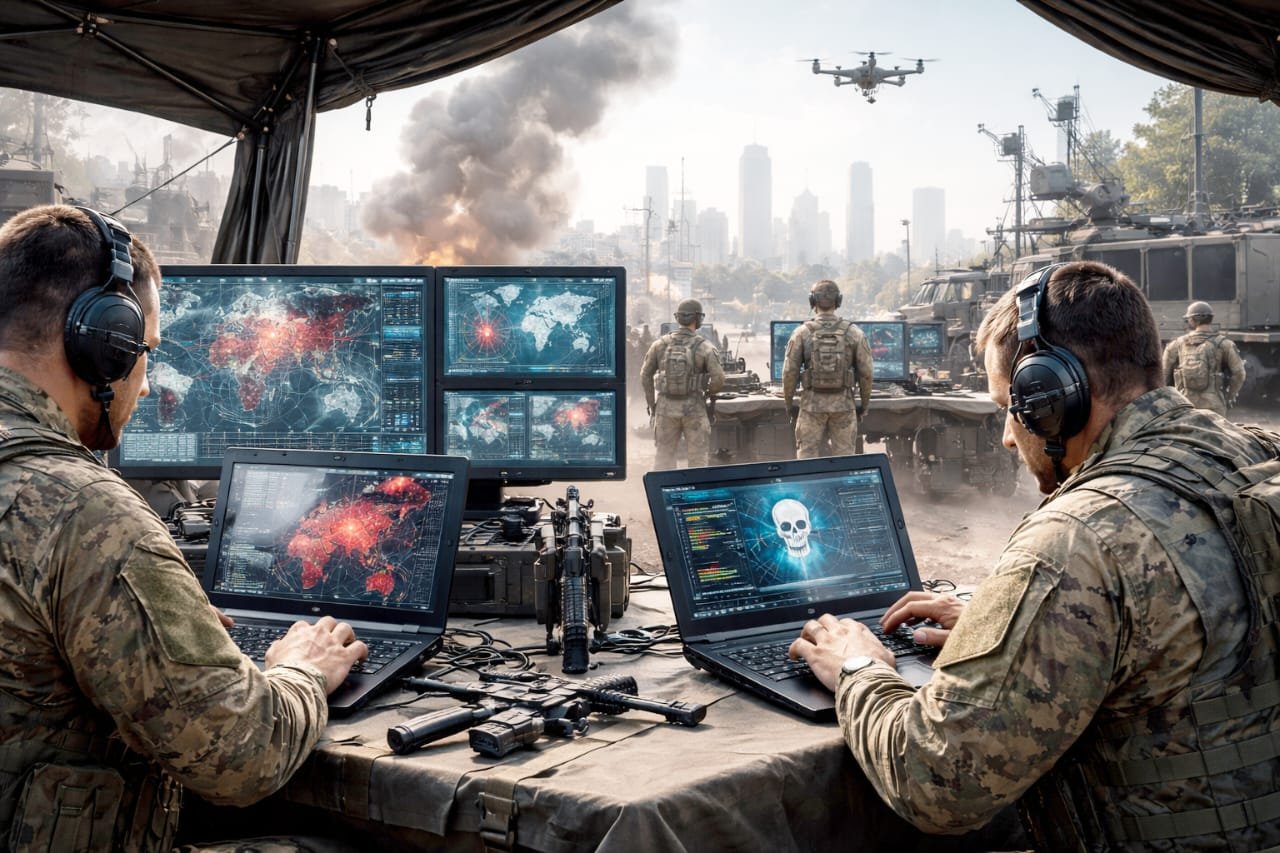
Modern wars are no longer confined to land, sea, air, and space. Today, a fifth domain has become central to conflict: cyberspace. Cyber warfare now plays a decisive role in shaping outcomes of wars, often operating alongside—or even before—conventional military action. Recent conflicts clearly demonstrate that digital battlefields are no longer theoretical; they are active, contested, and highly consequential.
WHAT IS CYBER WARFARE?
Cyber warfare involves the use of digital attacks to infiltrate, disrupt, manipulate, or destroy an adversary’s information systems and critical infrastructure. These operations may be conducted by states directly or through proxies and can target military systems, civilian infrastructure, financial institutions, and public opinion itself.
Unlike traditional warfare, cyber operations are often covert, continuous, and difficult to attribute, making escalation and retaliation complex.
CYBER WARFARE IN MODERN CONFLICTS
- Cyber Warfare in the Russia–Ukraine War
The Russia–Ukraine conflict is one of the clearest examples of cyber warfare y into modern combat.
Before Russia’s full-scale invasion in 2022, Ukraine faced massive cyberattacks on government websites, banks, and communication networks. Malware such as wiper attacks was used to erase data from Ukrainian systems, aiming to cripple state functions ahead of kinetic operations.
During the war:
- Ukrainian power grids and telecommunications networks were repeatedly targeted.
- Satellite communication systems were disrupted to affect battlefield coordination.
- Both sides engaged in cyber espionage to gather military and political intelligence.
This conflict showed that cyber operations are not isolated events but part of a hybrid warfare strategy, combined with missiles, drones, and ground forces.
- Cyber Operations in the Israel–Hamas Conflict
In the Israel–Hamas conflict, cyber warfare has played a critical supporting role, particularly in information warfare and digital disruption.
Pro-Israel and pro-Hamas hacker groups launched cyberattacks against Government and military-affiliated websites, Media outlets and financial platforms.
At the same time, social media platforms became battlegrounds for disinformation campaigns, manipulated images, and psychological operations aimed at shaping global and regional opinion.
This conflict illustrates how cyber warfare increasingly targets perception, narrative control, and public morale, rather than only physical infrastructure.
- Iran, Israel, and the Shadow Cyber War
Iran and Israel have been engaged in a long-running, largely covert cyber conflict that rarely spills into open war but has real-world consequences.
Examples include:
- Cyberattacks on Iranian industrial and nuclear-linked systems
- Iranian cyber operations targeting Israeli water infrastructure and transportation systems.
These operations are carefully calibrated to remain below the threshold of full-scale war, highlighting how cyber warfare enables strategic pressure without direct military confrontation.
- Cyber Warfare in the Azerbaijan–Armenia Conflict
During and after the Nagorno-Karabakh conflict, cyber operations were used to:
- Deface government websites
- Leak sensitive data
- Disrupt communication platforms
Hacktivist groups aligned with both sides played an active role, demonstrating how cyber warfare allows non-state actors and civilians to participate in conflict directly.
KEY FORMS OF CYBER WARFARE IN RECENT CONFLICTS
1. Cyber Espionage
It is used extensively in the Ukraine war to steal battlefield intelligence, diplomatic communications, and military planning data.
2. Infrastructure Sabotage
Attacks on power grids, satellite systems, and communications networks have caused real civilian disruption, especially in Ukraine.
3. Information and Psychological Warfare
Disinformation campaigns in Ukraine and in West about Gaza show how cyber tools are used to influence domestic and international opinion.
4. Hacktivism and Proxy Warfare
Volunteer hacker groups now act as informal cyber militias, blurring the line between state and civilian involvement.
WHY CYBER WARFARE IS SO EFFECTIVE
Recent wars show why cyber warfare has become indispensable:

- It is cheap compared to conventional weapons.
- It allows plausible deniability.
- It can paralyze civilian life without physical destruction.
- It operates continuously, even in peacetime.
- A cyberattack can disrupt hospitals, banking systems, or communications faster than airstrikes.
CYBER OPERATIONS AND MALWARE: REAL EXAMPLES FROM MODERN CONFLICTS
Cyber operations are the practical tools of cyber warfare. They use malware, network intrusions, and digital manipulation to achieve military or political objectives. Recent wars show that these tools are no longer experimental — they are operational weapons.
- Stuxnet – Cyber Sabotage as a Weapon
Conflict context: Iran–Israel / US–Iran shadow conflict.
Type: Infrastructure sabotage malware
Stuxnet is considered the first true cyber weapon. It targeted Iran’s nuclear enrichment facilities by manipulating industrial control systems while reporting normal activity to operators.
Why it matters;
Caused physical damage without bombs,
Proved cyber tools can destroy real-world infrastructure,
Set the precedent for cyber warfare as state policy.
Stuxnet changed how states think about warfare — code could now replace missiles in certain missions.
- NotPetya – Economic Warfare Through Malware
Conflict context: Russia–Ukraine conflict
Type: Destructive malware (wiper disguised as ransomware)
NotPetya initially targeted Ukrainian institutions but rapidly spread worldwide, affecting shipping, energy, and logistics companies.
Impact;
Billions of dollars in global damage
Ukrainian banks, ministries, and transport systems disrupted
Demonstrated how cyber operations can escalate beyond borders
NotPetya showed that cyber warfare can unintentionally (or deliberately) become global economic warfare.

- DDoS Attacks – Digital Blockades
Conflict context: Ukraine war, Israel–Hamas conflict
Type: Denial-of-Service operations
Distributed Denial-of-Service (DDoS) attacks flood websites and servers with traffic, forcing them offline.
Targets are Government portals, Banks and Media outlets
The Purpose was to Disrupt communication, Undermine public confidence and Create confusion during crises.
Though technically simple, DDoS attacks are powerful during wartime because they strike information access and trust.
- Viasat Satellite Disruption – Attacking Connectivity
Conflict context: Russia–Ukraine war
Type: Cyberattack on satellite communications
A cyberattack disabled satellite modems used by Ukrainian forces and civilians, disrupting military coordination and civilian communications.
This attack Targeted dual-use infrastructure, Affected thousands across Europe and Highlighted vulnerability of space-based systems.
This was a clear example of cyber warfare directly shaping battlefield communications.
- Israel-Hammas Hacktivist Operations
Conflict context: Israel–Hamas war
Type: Hacktivism, website defacement, data leaks
Pro-Israel and pro-Hamas hacker groups targeted Government websites, Media platforms and financial services.
The Strategic aim was psychological impact, Symbolic disruption and Narrative dominance.
These operations show how cyber warfare increasingly includes non-state actors and ideological volunteers.
Why These Examples Matter
These malware campaigns and cyber operations demonstrate that:
- Cyber warfare is not hypothetical,
- Digital attacks can cause physical, economic, and psychological harm,
- Modern wars are fought simultaneously in physical and digital domains,
- Cyber weapons are now a permanent feature of global conflict.
CONCLUSION
From Ukraine to Gaza, from Israel–Iran cyber clashes to regional conflicts, cyber warfare has become a defining feature of modern conflict. The digital battlefield is always active, rarely visible, and increasingly decisive. Understanding cyber warfare is no longer optional for governments, militaries, or societies—it is essential for survival in an interconnected world.